Start with the room
Choose a position that can support the intended aquarium and still allow people to move around it. Consider direct sunlight, nearby heat sources, floor transitions, door swings and the route used to bring the tank into the room. A visually calm location may still be difficult if the rear or side panels cannot be reached.
Measure access before selecting volume. Door widths, stair turns and lift dimensions can determine what is practical. The final decision should be checked with the relevant building, moving and installation professionals. Do not assume a floor, cabinet or wall can carry a load without suitable assessment.
Support and clearance
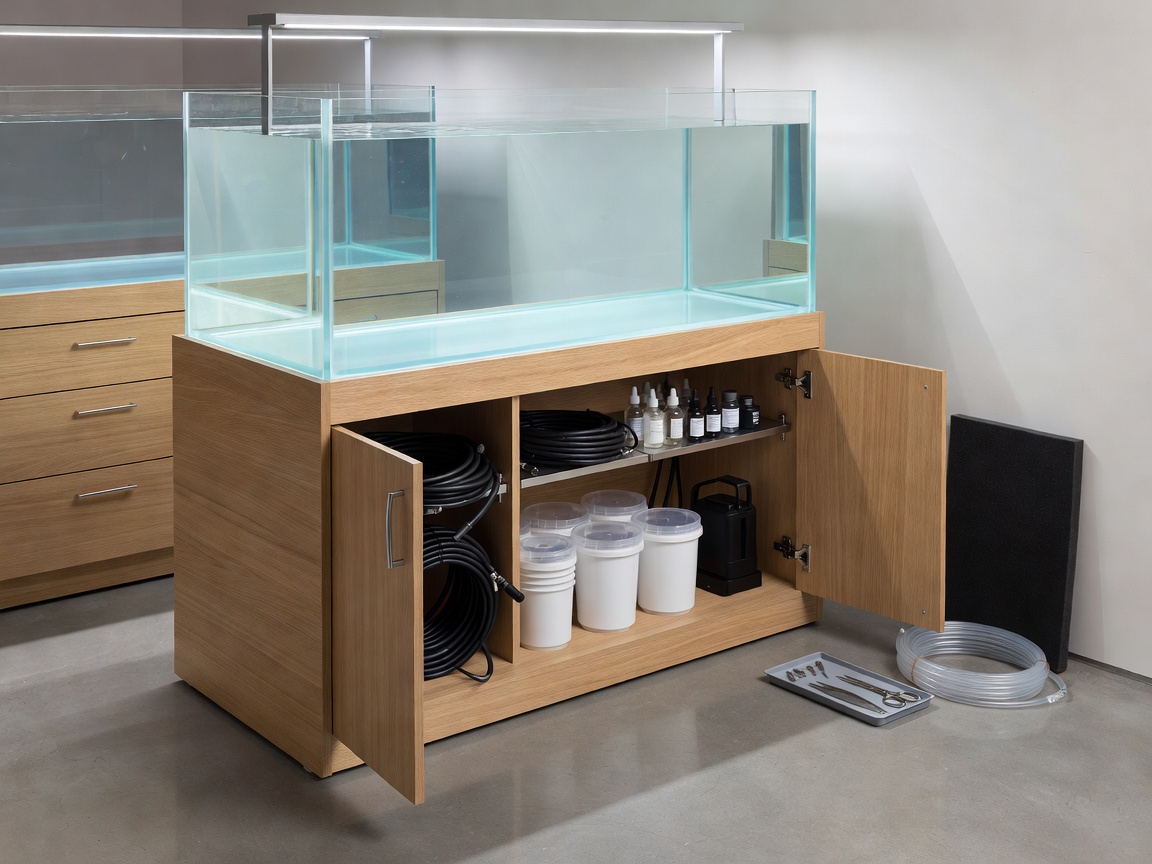
The cabinet or support must be appropriate for the aquarium design. A level, stable base matters. It should also leave usable clearance for filter bodies, tubing, lighting controls and inspection points. Concealed equipment can look tidy but become difficult to maintain.
Plan space above the aquarium for lighting and routine access. Plan space below it for filtration, cable routing and isolation points. Electrical work, structural changes and plumbing should be handled by appropriately qualified professionals. Avoid improvised lifting or modifications.
Equipment planning
Filtration requirements depend on aquarium volume, livestock, aquascape, feeding pattern and maintenance approach. Mechanical filtration removes suspended material. Biological filtration provides surfaces where beneficial microbial communities can develop. Chemical media may have a specific role, but it is not universally necessary.
Lighting affects viewing, planted growth and daily timing. Heating or cooling needs depend on the system and room conditions. Marine installations often require more equipment planning than straightforward freshwater systems, including attention to salinity management, circulation and access around the display.
Sequence and commissioning
A practical sequence is room preparation, support placement, empty-tank positioning, equipment routing, substrate and hardscape planning, controlled filling, equipment checks and observation. Commissioning is not a single moment. The system needs time for its operating pattern to become clear.
Record equipment locations, service dates, settings and observations. Keep manufacturer instructions with the system. If leaks, unusual noise, unstable temperature or animal-health concerns appear, stop and seek an appropriately qualified professional. This site does not provide structural, electrical or veterinary instructions.
Freshwater and marine differences
Freshwater systems can have simpler equipment and water-care routines, although requirements vary widely. Marine systems commonly involve greater sensitivity to salinity, evaporation, circulation and filtration choices. Neither category is automatically easier. The right choice depends on the room, available time, intended inhabitants and maintenance capacity.
Good for
- New residential aquarium projects.
- Planted and contemporary display tanks.
- Pre-installation room and access reviews.
- Commercial displays requiring planned service access.
What to know
- Support, lifting and electrical work need qualified assessment.
- Installation choices affect every later maintenance visit.
- Exact equipment selection requires system-specific information.