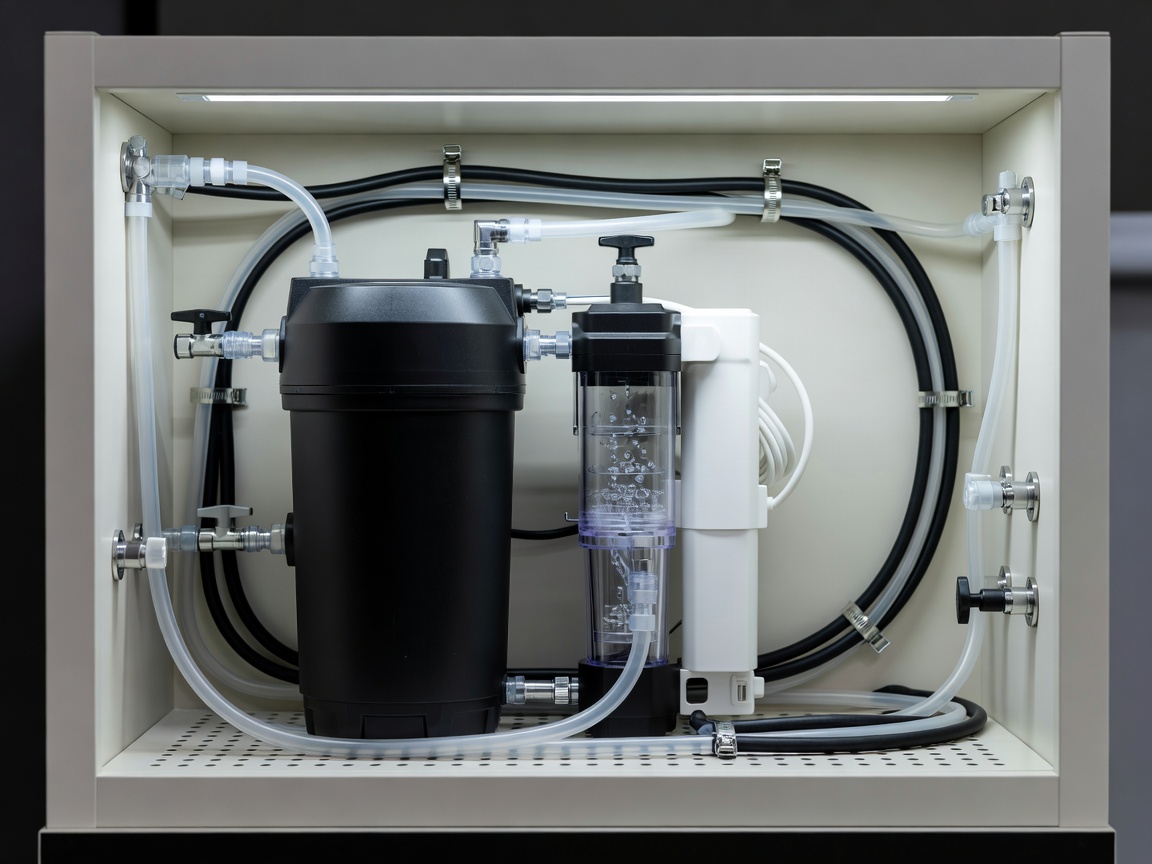
Three filtration roles
Mechanical filtration captures suspended particles. It supports clearer water but needs appropriate inspection and cleaning. Biological filtration provides surfaces for microbial communities that participate in the aquarium’s nitrogen cycle. Chemical filtration uses media intended to affect specific dissolved substances.
These roles may be combined in one filter or distributed across several components. No category is automatically best. Selection depends on aquarium volume, inhabitants, feeding, layout, available space and the maintenance routine.
Circulation and pumps
Circulation moves water through the aquarium and equipment. Pumps, outlets and intakes should be positioned with the aquascape and inhabitants in mind. Excessive or poorly directed flow can create practical problems, while inadequate movement can leave stagnant areas.
Listen for changes in pump sound. Check accessible tubing and intake areas during routine service. Do not dismantle or repair powered equipment while connected. Electrical inspection and repair should be completed by a qualified professional.
Lighting
Lighting supports viewing and may support aquatic plants or other organisms depending on the system. Consider mounting, timer access, heat, splash protection and replacement planning. A lighting schedule should be consistent with the aquarium’s intended use.
Heating and cooling
Heating and cooling requirements depend on room temperature, aquarium design, inhabitants and equipment location. A heater should not be treated as a complete temperature-control plan. Observe both the display and the equipment indicators.
Cooling systems may require clearance, airflow and additional maintenance. Do not improvise electrical or thermal modifications. Seek manufacturer or qualified technical guidance for faults.
Aeration and gas exchange
Aeration introduces movement at the surface and may support gas exchange. Its value depends on circulation, surface movement, temperature and the aquarium design. Air pumps, stones and tubing also need inspection and can add sound or visual impact.
Placement and access
Place equipment where it can be reached without disturbing the whole aquarium. Label cables and tubing. Leave enough room to remove serviceable components. Concealment is useful only when it does not prevent inspection.
Lifecycle planning
Record installation dates, model information, service observations and signs of wear. Replacement planning is easier when equipment has an identified role and an accessible location. Exact lifecycles depend on the product, use and environment. Do not rely on invented performance claims or universal replacement intervals.
Good for
- New aquarium equipment planning.
- Filter and circulation reviews.
- Lighting, heating and cooling layouts.
- Maintenance-access improvements.
What to know
- Technical specifications must match the actual system.
- Electrical repairs require qualified professionals.
- Equipment does not remove the need for observation.